
Have you ever reached the end of the month and wondered:
“Where did all my money go?”
You paid your bills. You didn’t make any huge purchases. Yet somehow, your bank account feels smaller than expected.
The problem isn’t your income.
It’s that your money doesn’t have a plan.
That’s where zero-based budgeting comes in.
This powerful budgeting method helps you assign every dollar a job before the month begins — so nothing is wasted, forgotten, or spent unintentionally.
In this guide, you’ll learn:
- What zero-based budgeting is
- How it works
- How to create one step-by-step
- Real examples
- Pros and cons
- Mistakes to avoid
By the end, you’ll know exactly how to control every dollar you earn.
What Is Zero-Based Budgeting?
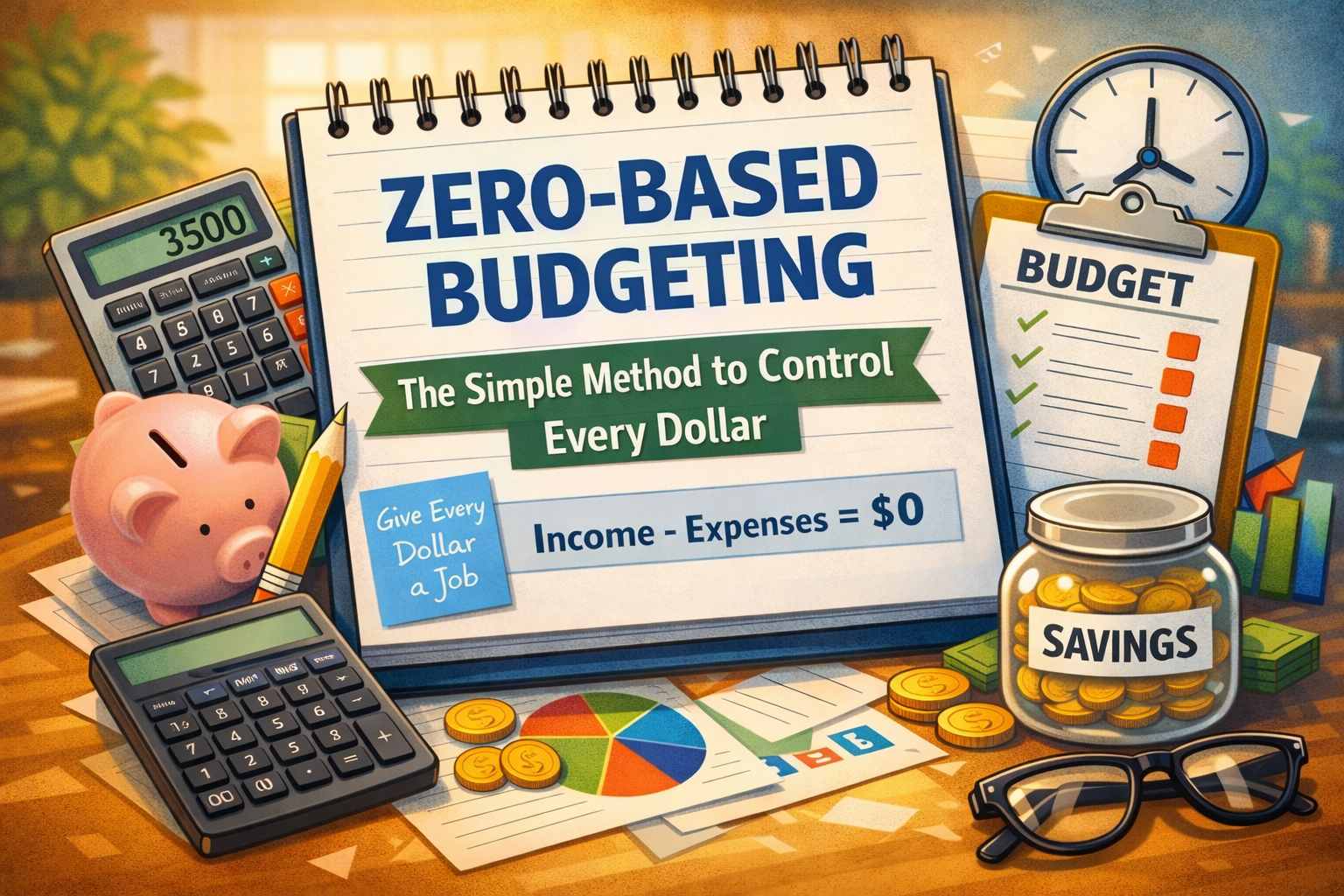
Zero-based budgeting is a budgeting method where your income minus your expenses equals zero.
That does not mean you spend all your money.
It means every dollar is assigned a purpose — whether that’s bills, savings, investing, or debt payments.
Simple Formula:
Income – Expenses = $0
If you make $4,000 per month, you give all $4,000 a job.
Nothing is left “unplanned.”
Where Zero-Based Budgeting Became Popular
While businesses have used zero-based budgeting for decades, it became widely known in personal finance through experts like Dave Ramsey, who teaches assigning every dollar a purpose before the month begins.
The idea is simple:
If you don’t tell your money where to go, it will disappear on its own.
How Zero-Based Budgeting Works
Most people follow this pattern:
Earn → Spend → Save what’s left (if anything)
Zero-based budgeting flips it:
Earn → Plan → Assign → Spend intentionally
Before the month begins, you decide:
- How much goes to rent
- How much goes to groceries
- How much goes to savings
- How much goes to debt
- How much goes to fun
Nothing is accidental.
Step-by-Step Guide to Creating a Zero-Based Budget
Let’s build one together.
Step 1: Calculate Your Monthly Income
Use your after-tax income.
Include:
- Paychecks
- Side hustle income
- Freelance work
- Consistent benefits
If your income varies, use the lowest expected monthly income to stay safe.
Example:
Monthly income = $3,500
That’s your starting number.
Step 2: List Your Fixed Expenses
These are expenses that don’t change much month to month:
- Rent or mortgage
- Utilities
- Insurance
- Internet
- Minimum debt payments
- Car payments
Example:
- Rent: $1,200
- Utilities: $200
- Insurance: $150
- Car payment: $300
- Internet: $80
Total fixed = $1,930
Remaining:
$3,500 – $1,930 = $1,570
Step 3: List Variable Expenses
These change monthly:
- Groceries
- Gas
- Dining out
- Personal spending
- Entertainment
Look at the past 2–3 months of bank statements for accuracy.
Example:
- Groceries: $450
- Gas: $250
- Dining: $200
- Entertainment: $100
Total variable = $1,000
Remaining:
$1,570 – $1,000 = $570
Step 4: Assign Money to Savings and Debt
Now allocate the remaining $570 intentionally.
For example:
- Emergency fund: $300
- Investing: $150
- Extra debt payment: $120
Total = $570
Remaining balance:
$0
Perfect.
Every dollar has a job.
Real-Life Zero-Based Budget Example
Income: $4,000
Needs:
- Rent: $1,500
- Utilities: $200
- Groceries: $500
- Transportation: $300
- Insurance: $200
Total Needs: $2,700
Wants:
- Dining: $250
- Subscriptions: $50
- Shopping: $150
Total Wants: $450
Savings & Debt:
- Emergency fund: $400
- Investing: $250
- Extra debt payment: $200
Total Savings/Debt: $850
Grand Total = $4,000
Remaining = $0
That’s zero-based budgeting in action.
Benefits of Zero-Based Budgeting
1. Total Financial Awareness
You know exactly where every dollar goes.
No guessing.
No surprises.
2. Faster Debt Payoff
Since money is assigned intentionally, you can aggressively allocate extra funds toward debt.
This builds momentum.
3. Higher Savings Rate
Savings isn’t an afterthought.
It’s planned before spending begins.
4. Reduced Impulse Spending
When you know your dining budget is $200, you think twice before overspending.
Clarity creates discipline.
5. Works for Any Income Level
Whether you make $2,000 or $10,000 per month, the system scales.
Downsides of Zero-Based Budgeting
No budgeting method is perfect.
Here are a few challenges:
- Takes time to set up initially
- Requires monthly adjustments
- Can feel restrictive at first
- Harder with unpredictable income
However, most people find that once they build the habit, it becomes easier each month.
Zero-Based Budgeting vs 50/30/20 Rule
You may have heard of the 50/30/20 rule.
Here’s the difference:
Zero-Based Budgeting
- Every dollar assigned
- Detailed categories
- Great for debt payoff
- More hands-on
50/30/20 Rule
- Percentage-based
- Simpler structure
- More flexible
- Less detailed tracking
If you want control and precision → zero-based is powerful.
If you prefer simplicity → percentage budgeting may fit better.
Common Mistakes to Avoid
1. Forgetting Irregular Expenses
Car repairs, holidays, annual subscriptions.
Solution:
Create sinking funds and divide annual costs by 12.
2. Not Tracking Spending
Even with a plan, you must monitor spending weekly.
3. Being Too Strict
Include fun money.
If you remove all enjoyment, you won’t stick to it.
4. Giving Up After One Bad Month
One overspend doesn’t mean failure.
Adjust and continue.
Tools for Zero-Based Budgeting
You don’t need expensive software.
Options include:
- Google Sheets
- Excel
- Budgeting apps
- Notebook method
- Printable templates
The best tool is the one you’ll actually use.
Frequently Asked Questions
Do I have to spend all my money?
No. You assign it to savings or investing — not random spending.
What if I overspend in one category?
Adjust another category to balance it back to zero.
Is zero-based budgeting good for beginners?
Yes — especially if you want clarity and structure.
How often should I update my budget?
Before the month begins and review weekly.
How to Make Zero-Based Budgeting Easier
- Automate savings
- Use sinking funds
- Budget before the month starts
- Review weekly
- Increase savings when income increases
The key is consistency.
Final Thoughts: Control Every Dollar
Zero-based budgeting isn’t about restriction.
It’s about intention.
When every dollar has a job:
- You stop wondering where money went.
- You reduce stress.
- You build savings faster.
- You gain confidence.
The goal isn’t perfection.
The goal is control.
Start this month:
- Write down your income.
- List your expenses.
- Assign every dollar.
- Adjust until you reach zero.
You’ll never look at your money the same way again.