
Budgeting doesn’t fail because people are bad with money. It fails because most budgets are too complicated.
You start motivated. You create 17 spending categories. You track every coffee. Two weeks later? You quit.
That’s exactly why the 50/30/20 rule has become one of the most popular budgeting methods in personal finance. It’s simple, flexible, and realistic.
Popularized by U.S. Senator Elizabeth Warren in her book All Your Worth, this budgeting strategy helps you control your money without feeling restricted.
In this guide, you’ll learn:
- What the 50/30/20 rule is
- How to calculate it
- Who it works best for
- Its pros and cons
- How to adjust it for your situation
By the end, you’ll be able to apply it immediately.
What Is the 50/30/20 Rule?
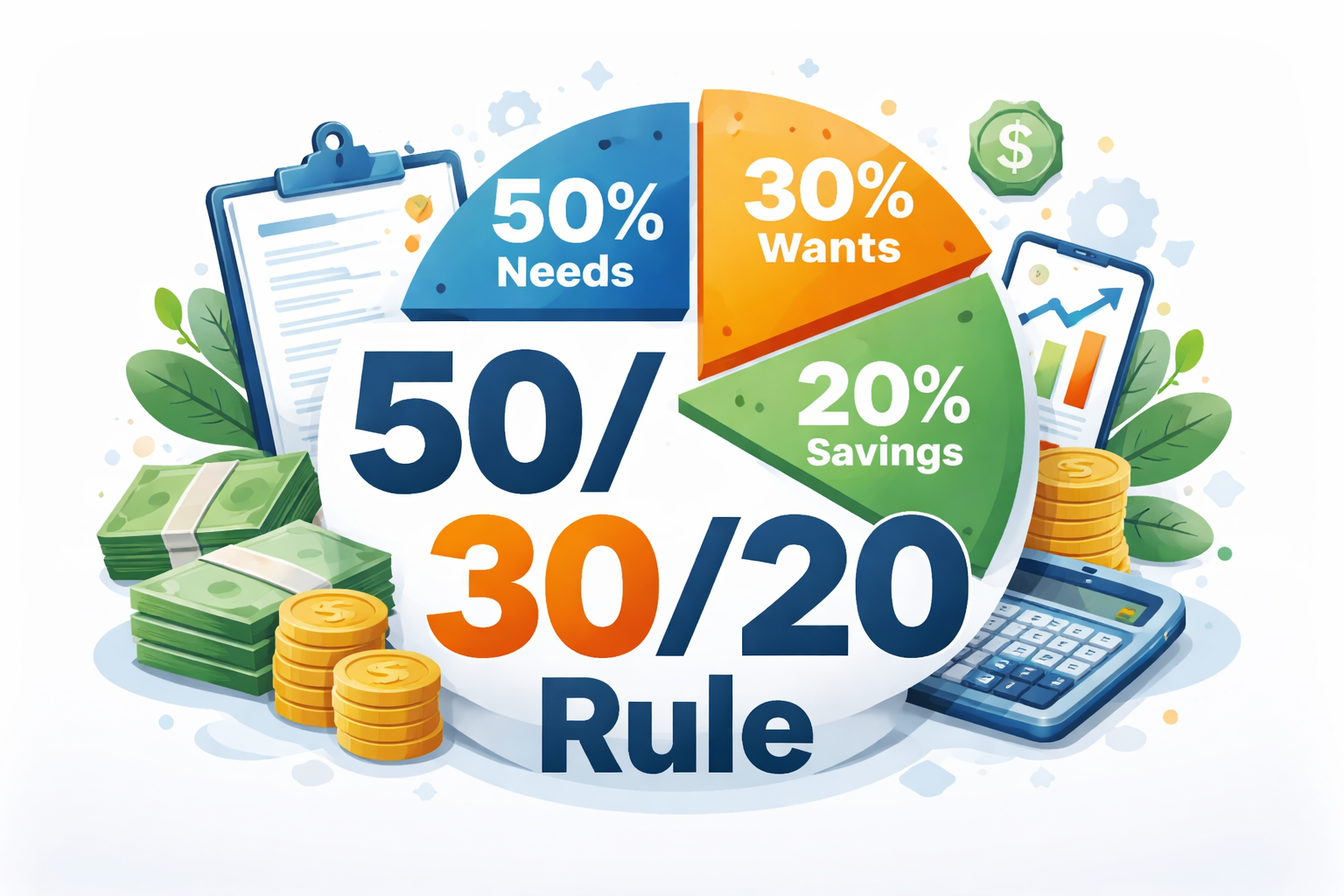
The 50/30/20 rule is a percentage-based budgeting method that divides your after-tax income into three simple categories:
- 50% for Needs
- 30% for Wants
- 20% for Savings and Debt Repayment
Instead of tracking dozens of detailed categories, you focus on keeping your spending within these three broad buckets.
Why does this work?
Because percentages are flexible. If your income changes, your budget automatically adjusts.
The 50% Category: Needs (Essential Expenses)
Needs are expenses you must pay to survive and function.
These include:
- Rent or mortgage
- Utilities (electricity, water, gas)
- Groceries
- Transportation
- Insurance
- Minimum debt payments
- Basic healthcare
If you lost your job tomorrow, these are the expenses you would still need to pay.
Common Mistake: Confusing Wants with Needs
Many people stretch the definition of “needs.”
For example:
- A basic car = Need
- A luxury car with high payments = Want
- Basic groceries = Need
- Premium organic specialty foods = Often a Want
If your “needs” are above 50%, housing is usually the biggest problem. Financial experts often suggest keeping housing below 30% of your income to make this rule easier to follow.
If your needs currently exceed 50%, don’t panic. The goal is progress, not perfection.
The 30% Category: Wants (Lifestyle Choices)
Wants are everything you enjoy but could technically live without.
Examples:
- Dining out
- Vacations
- Streaming subscriptions
- Shopping
- Gym memberships
- Hobbies
- Upgraded phone plans
This category is important.
Many strict budgets fail because they eliminate fun completely. The 30% rule allows you to enjoy life without guilt — as long as it fits within your limit.
If you need to cut expenses, this category is usually where adjustments happen first.
The 20% Category: Savings and Debt Repayment
This is the wealth-building category.
The 20% portion goes toward:
- Emergency fund
- Retirement accounts (401(k), IRA)
- Investments
- Extra debt payments (beyond minimums)
Minimum debt payments belong in “needs.” Anything extra goes here.
Why is 20% powerful?
Because consistently saving 20% of your income can completely transform your financial future. Over time, compound growth turns small monthly contributions into large wealth.
If you’re new to saving, start with building a 3–6 month emergency fund before aggressively investing.
How to Calculate Your 50/30/20 Budget (Step-by-Step)
Let’s break it down.
Step 1: Calculate Your After-Tax Income
This is your take-home pay after taxes and deductions.
Example:
You earn $4,000 per month after taxes.
Step 2: Multiply by Each Percentage
- Needs (50%): $4,000 × 0.50 = $2,000
- Wants (30%): $4,000 × 0.30 = $1,200
- Savings (20%): $4,000 × 0.20 = $800
Step 3: Compare to Your Current Spending
Now review your bank statements from the past 2–3 months.
Ask:
- Are my needs above $2,000?
- Are my wants above $1,200?
- Am I saving at least $800?
This comparison shows where adjustments are needed.
Why the 50/30/20 Rule Works
There are three major reasons this budgeting method is effective:
1. It’s Simple
Three categories are easier to manage than twenty.
2. It’s Flexible
If you get a raise, your savings automatically increase.
If your income drops, your budget scales down proportionally.
3. It Prioritizes Saving
Many people save “whatever is left.” This rule makes saving a non-negotiable 20%.
Who Should Use the 50/30/20 Rule?
This budgeting method works best for:
- Beginners learning to manage money
- Young professionals
- People who feel overwhelmed by detailed budgets
- Anyone who wants structure without micromanaging every expense
However, it may not fit everyone.
When the 50/30/20 Rule May Not Work
High Cost-of-Living Areas
In expensive cities, rent alone can exceed 50% of income.
Very Low Income
If you’re barely covering essentials, hitting 20% savings may not be realistic yet.
Aggressive Financial Goals
If you want early retirement or rapid debt payoff, 20% may not be enough.
In these cases, adjustments are necessary.
How to Adjust the 50/30/20 Rule
The rule is a guideline, not a law.
Here are some variations:
60/30/10
For high living costs where needs are unavoidable.
50/20/30
For aggressive savers who want faster wealth growth.
70/20/10
For beginners focused primarily on stabilizing essentials.
The key principle remains the same:
Control essentials. Enjoy some lifestyle. Always save something.
Common Mistakes to Avoid
1. Ignoring Irregular Expenses
Car repairs, annual subscriptions, holiday gifts — these can destroy your budget if not planned for.
Divide annual costs by 12 and include them monthly.
2. Not Tracking Spending
Even with broad categories, you still need awareness.
3. Increasing Lifestyle with Every Raise
When income increases, avoid expanding your wants automatically. Instead, increase savings.
Tools to Track Your 50/30/20 Budget
You don’t need complicated software.
Simple options include:
- Google Sheets
- Excel
- Budgeting apps
- Bank spending summaries
- Cash envelope system
The best tool is the one you’ll actually use consistently.
Example: Real-Life Scenario
Let’s say Sarah earns $3,500 per month after taxes.
Her ideal allocation:
- Needs: $1,750
- Wants: $1,050
- Savings: $700
After reviewing her spending, she discovers:
- Needs: $2,100
- Wants: $900
- Savings: $500
Her housing costs are too high.
Instead of giving up, she:
- Reduces utility bills
- Negotiates insurance
- Cuts unnecessary subscriptions
- Redirects $200 toward savings
Progress over perfection.
Is the 50/30/20 Rule Good for Paying Off Debt?
Yes — with a small adjustment.
If you have high-interest debt:
- Keep minimum payments in “needs.”
- Use most of your 20% savings bucket for extra debt payments.
- Once debt is gone, redirect that 20% to investing.
This builds momentum.
Long-Term Impact of the 20% Rule
Saving 20% consistently can mean:
- A fully funded emergency account
- Retirement security
- Investment growth
- Financial independence
- Reduced stress
Over 20–30 years, disciplined saving often matters more than picking perfect investments.
Consistency beats complexity.
Final Thoughts: Should You Use the 50/30/20 Rule?
If you want a budgeting method that is:
- Simple
- Flexible
- Easy to remember
- Realistic
- Sustainable
Then yes — the 50/30/20 rule is a strong starting point.
It’s not about perfection.
It’s about awareness, balance, and steady progress.
Start today:
- Calculate your after-tax income.
- Apply the percentages.
- Adjust gradually.
- Track monthly.
Your money should work for you — not stress you out.